




Spaces to Grow
The property market ramps up for the BPO industry's bullish demands and Roadmap 2022.
 It's s a visible manifestation of the Philippines's vibrant economy: hundreds of thousands of young men and women swarming into state-of-the-art buildings at all hours of the day, all part of the multibillion-dollar business process outsourcing (BPO) industry. Such is the strength of this sector that its revenues were forecast to have reached US$25 billion (P1.21 trillion) in 2016, and was close to overtaking remittances from overseas Filipino workers, which grew to US$25.77 billion (P1.24 trillion) in 2015.
Benedict Hernandez, chairman of the Executive Committee of the Information Technology and Business Processing Association of the Philippines (IBPAP), weighs in. "With about US$24 billion worth of revenues so far, we must make sure that we continue to be competitive and grow our business," he underscores, "so we can create more jobs. That is about 100,000 new jobs a year."
He points out that the employment generated by the BPO industry impacts other sectors of society with a multiplier effect: "For every direct [BPO] employee, we have four indirect jobs created in other industries - transport, food, retail, and real estate - that grow around the business."
Need for space
With a large, English-speaking population and service-oriented culture, the country has long been a preferred destination for international locators. The first international call center, Accenture Global Resource Center, opened here in 1992. The BPO industry has come a long way since then, and so has the real-estate sector. Hernandez recalls that 15 years ago, there was a need for property developers to understand the 24/7 nature of the business, the high density-per-floor requirement, exit requirements, and the need for telecommunication to be integrated into the building plans.
 Today, a typical BPO company employs around 1,200 people, requiring some 6,500 square meters (sqm) of office space. With the combined workforce currently at 1.3 million, the BPO industry occupies approximately 6.4 million sqm of office space. "We have been doubling in size every six years, but the highest growth rate actually happened between 2000 and 2004," explains David Leechiu, chief executive officer of Leechiu Property Consultants. "We were coming from such a small base of 1,000 people to 60,000 in a year. We first hit 500,000 in 2010."
He foresees a gradual rise as more companies begin setting up operations offshore in the Philippines, adding that the BPO industry aspires to grow to 2.6 million people by 2022. This will require some 12.8 million sqm of space, a challenge for which the real-estate market needs to prepare.
In Manila, office rent ranges from P500 to P1,200 per sqm; in the provinces, it varies from P250 to P400 per sqm. This translates to a monthly rent of between P2 million and P8 million for one office location.
"Despite the massive space the BPO industry occupies," Leechiu says, "their next biggest expense after labor is not rent: it is power." In 2015, for example, the SM Group's corporate office building in Pasay City consumed an average of P2.4 million per month in electricity. Monthly averages reached P1.8 million at the SM Cyber 2 building in Makati; and in Alabang, Muntinlupa City, about P3 million at the 12-story Aeon Prime building and P2.2 million at the Filinvest Cyberzone.
Although not direct customers of the Manila Electric Co. (Meralco), these corporate offices receive support from Meralco through regular Energy Efficiency forums provided for the engineers and tenants of these buildings. The forums share power-saving tips and explain the breakdown of the electricity bill.
Out of Manila
The BPO industry, ironically, turned Metro Manila into a victim of its own success. The National Capital Region comprises about 70 to 80 percent of the footprint of the outsourcing business. This volume, however, is straining the infrastructure that attracted BPOs in the first place.
"We only have a population base of 12 to 15 million," Leechiu stresses. "Tokyo, one of the largest cities in the world, has a population base of close to 40 million, yet you don't feel the traffic because it has amazing infrastructure."
The BPO footprint alone, he emphasizes, is not the cause of Metro Manila's congestion but also its so-called land lock, caused by informal settlers, restricted land use, and a mass-transport system unable to alleviate traffic problems.
 "Part of it is poverty," reflects Leechiu, "and part of it is the need to fix what we neglected for 30 years. The challenge for the country is not just how to build infrastructure, but how to deliver the labor pool so that we can generate qualified and employable graduates."
Despite these difficulties, BPO companies will continue to flock to Metro Manila until other regions can mobilize their untapped potential. Leechiu enumerates the attributes that provinces must cultivate to attract outsourcing businesses. These include a sufficient talent pool; political support for the BPO industry; an adequate fiber-optic infrastructure; site resilience to natural calamities; access to local transport systems; and safety.
He believes shifting BPO companies to the provinces and developing the property markets there is the easy part. The real challenge lies in developing and sustaining a labor pool that can meet strict global standards.
Securing government support
To help create its world-class talent pool, IBPAP works hand-in-hand with the Commission on Higher Education, the Technical Education and Skills Development Authority, and the Department of Education in developing industry-relevant subjects and courses.
"We are always in discussions with lawmakers and the executive departments on many things," Hernandez shares. "We work with them on trade promotion, and on hosting prospect locators with outbound missions. We work a lot with the education and training agencies of the government, we work on policies and around any issues that might impact our industry."
A concern is President Rodrigo R. Duterte's declaration of "economic separation" from the US, the main source of BPO investment. This caused a stir in the local business community, although Hernandez is quick to say that, "In reality it is business as usual. Our companies and employees continue to run as normal."
He also points out that IBPAP's partnership with several government agencies, including the Departments of Trade and Industry, of Information and Communications Technology, and of Finance, continues to be strong and consistent.
Investing ahead
To help ensure the uninterrupted growth of the BPO industry, IBPAP has created Roadmap 2022, a comprehensive six-year plan that looks at challenges and opportunities, and seeks to nurture the industry's needs in the areas of education, business environment and countrywide development.
 The road map also places the emphasis on investing in the Philippine brand and its competitiveness in the world market. "The developers put in US$100,000 (P4.8 million) each," Leechiu reveals, "raising US$1.1million (P53.04 million) to sponsor and fund Roadmap 2022." These developers include Ayala Land Inc., Double Dragon Properties Corp., Federal Land Inc., Filinvest Development Corp., Globe Telecom, Leechiu Property Consultants, Megaworld Corp., PLDT, Property Company of Friends Inc., Robinsons Land Corp., and SM Prime Holdings Inc.
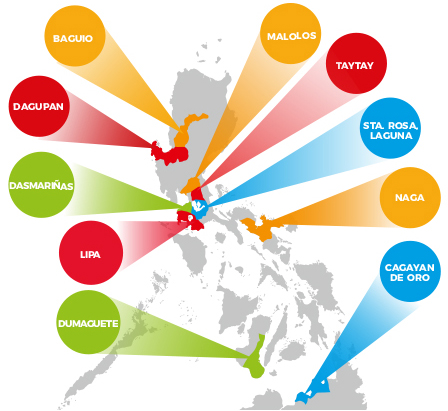 "They are all competitors," he says, "but they are all working together to make sure the BPO industry remains viable." Hernandez emphasizes the importance of unified action to meet the challenges ahead. "Our collaboration and partnership will remain key to realizing the new roadmap ambitions, especially as we focus on more countryside development."