



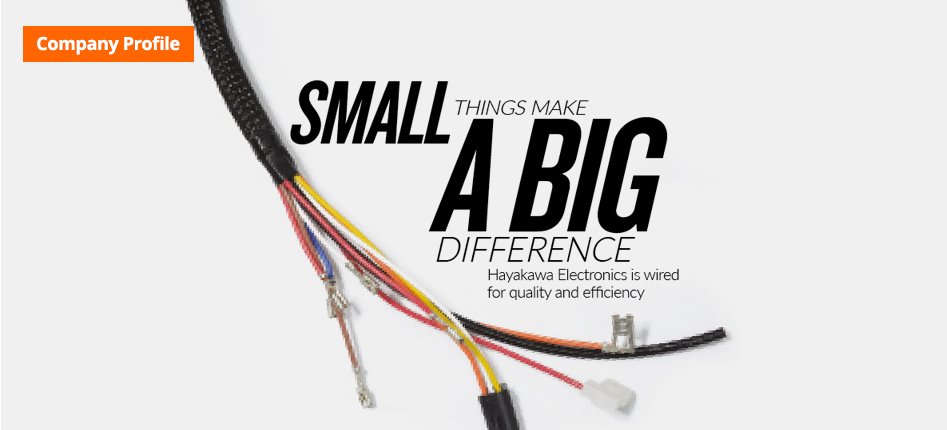
Small things make a big difference
BY JING LEJANO
Hayakawa Electronics is wired
for quality and efficiency
At Hayakawa Electronics Philippines Corp. (HEPC), an employee at one of the work stations is intent on the task at hand. Her head bowed and eyes focused, she deftly positions,cuts,strips, and splices wires. Her hands move from muscle memory, as if from years of practice, not once does her gaze dart up to the instruction guide illustrating the chronological steps of the procedure.
She's making a wire harness: hardly a glamorous product, yet absolutely essential in many vehicles and appliances. These wire harnesses have transformed HEPC into a booming company with a registered capital of P100 million.
Well-trained and well-connected
One of the earliest locators at the Cavite Economic Zone (CEZ) in Rosario, HEPC is a contract manufacturer of wire harnesses for automotive electronics, office machines, and automated banking. Its wire harnesses find their way into head lamps, car speakers, and sensor components of modern automobiles, among others; in printers and photocopiers; and in money-counting and automated teller machines. The factory's output of wire harnesses is exported directly to Europe, Japan, the US, and Asia.
The company is a wholly owned subsidiary of Japan's Hayakawa Densen Kogyo Co., Ltd, which has operations in the United Kingdom, Hungary, the Czech Republic, China, India, Thailand, Singapore, the Philippines, Vietnam, Japan, Mexico, and the United States. HEPC started its Philippine operations in 1990 with just 24 engineers.
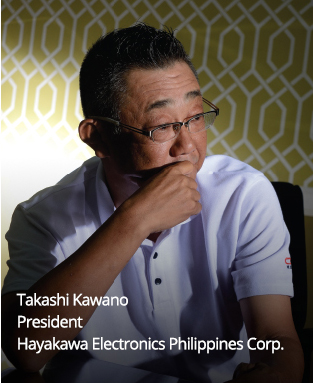
Takashi Kawano, HEPC president, reveals the Philippines's primary attraction for the company was its highly skilled workers. "Filipino workers are not only fluent english speakers," he explains, "they also proved to be high-potential employees."
His conversation, peppered with Filipino phrases, hints at his long-time residency in the country; clearly he enjoys working here. Filipinos are also quick learners, a crucial trait in a business that is constantly evolving. HEPC regularly puts workers through training programs for every step of the assembly process, and invests heavily in educational programs.
Kawano notes that local employees are sometimes sent for further training to its sister operations in Thailand and Vietnam."We wish for
Bound together for efficiency
What makes the business of wire harnesses recession-resistant is the products's ubiquity in electrical machinery. Wire harnesses consolidate wires that transmit signals or electrical power, making installation and replacement fast and easy. Bound together with insulating materials, they are flame-retardant, and better secured against moisture, vibrations and abrasion.
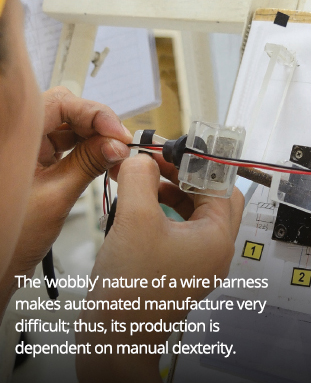
The "wobbly" nature of a wire harness makes automated manufacture very difficult;thus, its production is dependent on manual dexterity.
Thin wires are routed through sleeves, branch-outs secured with fabric tape, terminals crimped onto more wires, and strands fastened with tape, clamps or cable ties.
Gradual yet excellent growth
In his talk with Japanese businessmen during the Philippine Economic Forum in Tokyo last October 26, Socioeconomic Planning Secretary Ernesto Pernia declared, "after more than two decades since the enactment of the BOT (Build-Operate-Transfer) program and law, which authorizes the financing, construction, operation and maintenance of infrastructure projects by the private sector, the need to improve the framework that governs PPP has surfaced."
Also Neda Director-General, Pernia stressed:"Amendments to the BOT Law and its implementing rules and regulations are among the priority legislations intended to raise the efficacy of private-sector participation and to keep policies attuned to the changing business environment."
However, Lim notes the gulf between intention and application. The issue of taxes became a deal breaker when the LRT-1 Cavite extension project was first offered to potential bidders.
"They wanted us to extend the train by another 11 kilometers," he narrates, "so we raised the issue of local taxes once the concessionaire takes over. The BAC (Bids and Awards Committee) did not respond and instead decided to proceed with the bid. All other bidders and even our consortium members backed out."
Having already spent so much time preparing for this project, MPIC decided to continue to pursue it by submitting a bid conditional on the government addressing the tax issue. This was deemed to be "non-responsive," thus leading to failed bid.
"The following day we received a call from the government asking why we considered taxes as a deal breaker", Lim recounts."We presented our calculations and this showed their estimates on taxes to be only 10 percent of our estimate."
He goes on to say that within two weeks, there was approval from Neda for the government to pay for the project's real -property tax. The project was bidded out again a few months later, but by then other bidders had lost interest.
The government now aims to exempt infrastructure projects with "national significance" from paying local taxes. "It has since learned that local taxes are a real issue that need to be addressed, that is why it is trying to amend the BOT law," Lim notes. "I supposed it's part of the learning curve".