



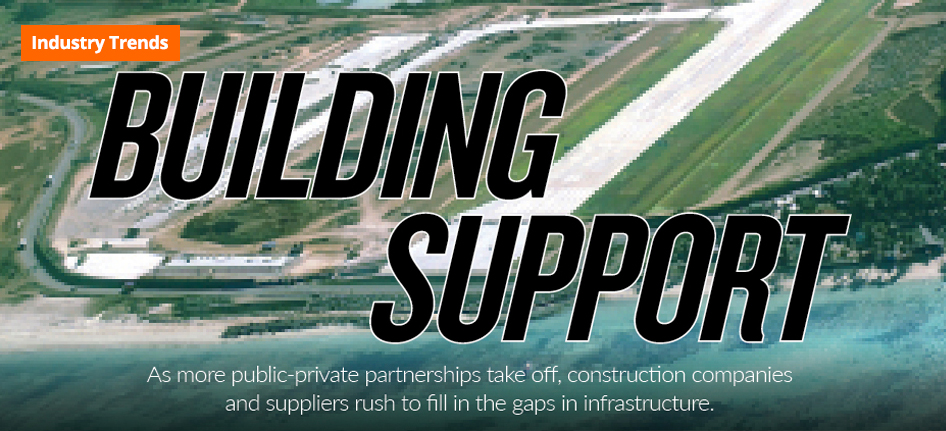
Building Support
As more public-private partnerships take off, construction companies and suppliers rush to fill in the gaps in infrastructure.
One might be forgiven for thinking of Metro Manila as one vast construction site. The seemingly endless spread of new developments and buildings add to the slow but steady expansion of infrastructure - elevated roadways, light-rail systems, bridges, expressways - meant to link the different parts of the mega city. The recent growth spurt of these infrastructure projects is due primarily to public-private partnership (PPP) initiatives, launched by the Aquino administration in 2012 and sustained by the Duterte administration. The program continues to attract large corporations such as Metro Pacific Investments Corp. (MPIC), San Miguel Corp. (SMC), and Ayala Corp. (see "Playing the Long Game" on page 16).
Much of the heavy lifting, however, is literally provided by the construction firms that transform these projects into reality. Despite the many challenges they encounter, companies like EEI Corp., D. M. Consunji Inc. (DMCI), and Capitol Steel Corp. are busier than ever.
From the ground up
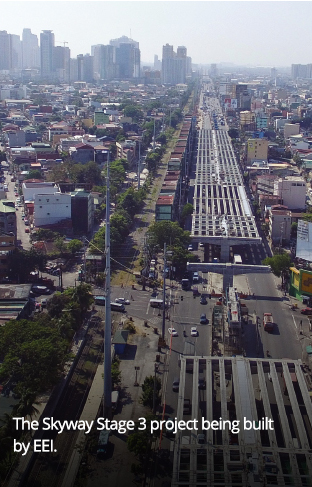
One of the country's oldest engineering companies, EEI Corp. began as an engineering equipment supplier in 1931. Over the decades, it participated in numerous construction projects all over the world. Today, as part of the Yuchengco Group of Companies, it engages in PPP projects that include the Caticlan International Airport, the Metro Rail Transit (MRT)-7, and the Skyway Stage 3 project section to connect Araneta Avenue to the A. Bonifacio station.
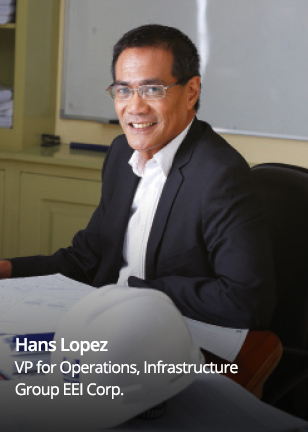
EEI Infrastructure Projects has partnered with SMC for the Ninoy Aquino International Airport (Naia) Expressway, and with MPIC for improvements to the North Luzon Expressway (NLEX). But Vice President for Operations, Infrastructure Group, Hans Lopez says EEI is open to becoming a direct project proponent, particularly for projects on which bigger firms may pass up.
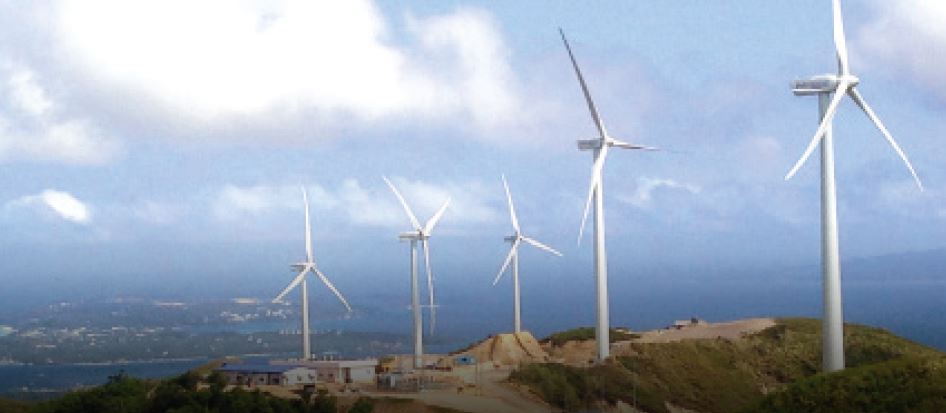
"Not only are we able to do high-rise buildings, malls, and hospitals," Lopez enumerates, "we have the capability to construct major infrastructure: wind farms, port projects, airport projects, elevated roadways, elevated railways, and bridges.
"And, of course, power plants, mining plants, processing plants, and heavy industrial facilities, which comprise the original core business of EEI."
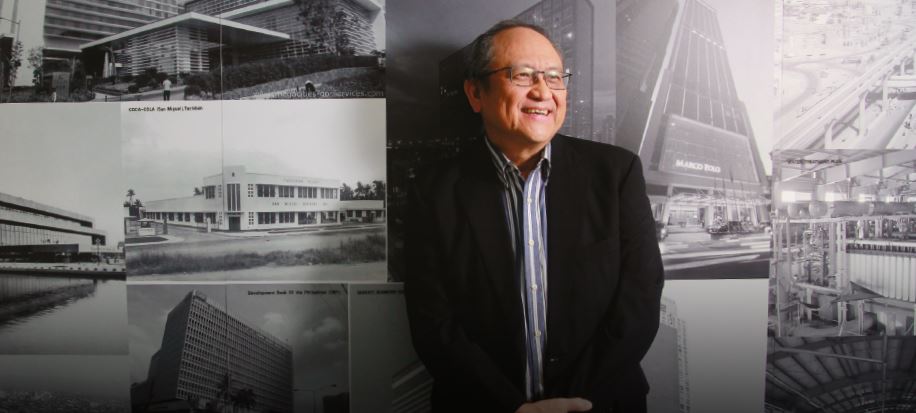
 Jorge A. Consunji, president and chief operating officer of DMCI, shares that his company worked on projects, such as the Tarlac-Pampanga-La Union Expressway (TPLEX), as both the contractor and its proponent. DMCI is also a contractor for the Naia Expressway, the next portion of which opened before Christmas; and Skyway Stage 3, on track for completion in April 2018. Established in 1954, DMCI's years of experience and versatility make it an attractive partner to directly undertake PPP projects, stresses Consunji.
"Some proponents have to rely on a third-party contractor. [But we] are one of the few companies that can construct a project as a contractor or, as a proponent, bring in strategic partners and raise the money."
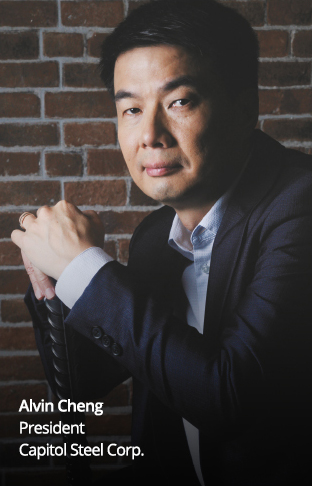
None of these projects would go anywhere without steel, which Capitol Steel Corp. supplies to PPP constructions. Company President Alvin Cheng reveals Capitol Steel bars strengthen the Naia Expressway and the Skyway Stage 3 Extension connecting the South Luzon Expressway (SLEX) to NLEX.
As a supplier, Capitol Steel needs to ensure all its rebars meet project specifications for timely deliveries. Cheng says this reinforces his company's solid reputation among its clients.
Risks and Rowa
Taking on PPPs is not for the faint of heart, even for companies as flexible as DMCI. All projects carry risk, and some bigger than others: construction, financing, design and completion. Operational risks require construction companies to ensure the safety of their personnel, the public, and the community. Even the weather can seriously affect project timelines.
The greatest source of concern for PPP proponents lies in financial risk, because investors must ensure each project's profitability over a horizon of up to 25 years.
DMCI remains eager to provide top-to-bottom service for minimal-risk projects, but Consunji admits the company prefers to work with strategic partners on riskier ventures.
President and COO DMCI
Supplies and demand
Project delays can adversely affect estimates for PPP suppliers such as Capitol Steel. "These expose us to additional raw-material cost escalation risks for the duration of the project," Cheng reveals.
Maintaining competitive prices is among the many challenges that keep him up at night. Raw materials easily account for 90 percent of Capitol Steel' costs. Although shipments can reach a million tons at the Port of Manila, Cheng notes that its Harbor Center has a capacity of only 400,000 tons.
 "The waiting time of vessels is 60 to 90 days!" he bemoans. "Imagine the cost, just for anchorage. We're being charged extra just to wait, and prices are always moving for commodities. We've opted for barging, and we unload it ourselves rather than be exposed to price volatility."
Pricing is just the first hurdle. He discloses: "Companies that supply to PPP infrastructure go through a stringent pre-qualification and financial capacity review."
These requirements, which take into account the ability to meet demanding delivery schedules, are far from unwelcome to the Capitol Steel boss. He views these criteria as necessary checks and balances for the public good, to ensure that PPP projects are aboveboard and well-built.
To satisfy the quality and supply requirements of its customers, the steel company is building a new plant in the first half of 2018 to potentially triple its capacity. The state-of-the-art steel plant will come from Europe and be competitive compared to other plants in the region.
Worthwhile pursuits
Challenges and risks aside, EEI, DMCI, and Capitol Steel remain keen to undertake more PPPs, believing this business model can solve the country's infrastructure shortfalls, especially in transportation and telecommunications.
"PPPs are very important to the Philippines right now," declares EEI's Lopez. "Rather than wait for the government to allocate some budget for a certain project, let the private companies do it: it's faster."
Previous PPP bid parameters included premium payments. For the Naia Expressway bid in 2013, SMC paid P11 billion, a few billion shy of the P15.86-billion total project cost. The expressway was intended to reduce travel time from the Manila Bay's World Trade Center to the airport, for the Asia-Pacific Economic Cooperation summit. San Miguel offered the premium payment in lieu of a subsidy of below P6.5 billion from the casino operators, who would directly benefit from the creation of the expressway.
 The national government intends to spend around P850 billion for infrastructure in 2017. This is part of the plan to ramp up infrastructure spending to around 5 to 7 percent of gross domestic product (GDP). By the end of its term, the Duterte administration aims to spend between P8.2 trillion and P9 trillion on various projects.
DMCI is eager to discover the PPP priorities of the current administration, and how it conducts the bids and awards for these projects. Admits Consunji, "We've heard that the government might no longer require a fee up front for the rights to operate."
Meanwhile, Cheng is encouraged by the government's commitment to continue the program and raise infrastructure spending over the next five years. "PPP is at its early stages," he shrugs. "Understandably, there is still a learning curve.
"But we are confident that the government is hitting its stride, and we will see a lot more PPP projects awarded. If they increase infrastructure spending to 5 percent [of GDP], it will be happy days for us."
However one may look at the ongoing construction boom, with its dust, cacophony and congestion, it is an indication of the vibrancy and promise of the Philippine economy. And when the needed infrastructure - shipping ports, airports, bridges, and power plants - are all in place, these will do more than link up towns with cities, or factories with markets. These will connect the entire Philippines to the prosperity deserved by all Filipinos.