



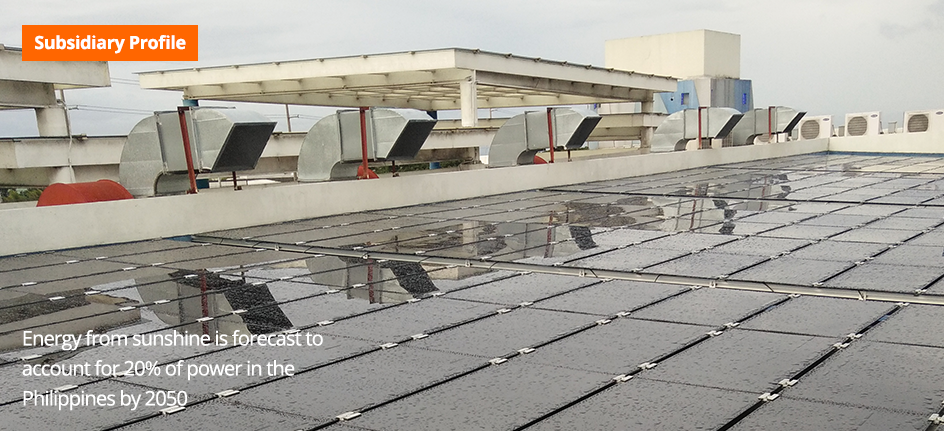
The Sun rises on Solar Power
Spectrum seeks to challenge and change the renewable-energy industry
by JING LEJANO
If the best things in life are free, it certainly applies to sunlight. But can the same ever be said for energy generated from the sun?
The technology to generate electricity from solar energy stretches back 178 years. The first photovoltaic (PV) cell was invented in 1839, but it wasn’t until 1954 that Bell Laboratories developed commercially viable PV cells.
The technology remained expensive; solar-generated electricity cost around US$76 per watt in 1977. Advances in design and manufacturing finally slashed the price of PV cells, and by 2015, solar energy costs were down to less than US$1.50 per watt.
This fuelled a boom in the solar-power industry in countries such as the United States, whose industry currently enjoys record growth, according to the Solar Energy Industries Association, a US trade association of solar energy and related businesses. An impressive 4,143 megawatts (MW) of solar PV, installed in the third quarter of 2016, produces 35.8 gigawatts of power. This translates into 1 MW installed every 32 minutes, enough to power 6.5 million homes.
Decentralization further sustained the slide in solar-power electricity prices. Today’s PV cells and storage systems, installed at the consumer’s premises, eliminate the need for costly infrastructure such as electric poles and substations.
A new dawn arrives
Several Philippine companies that invested in solar technology got mixed results: their system didn’t work well, or their contractors either provided insufficient support or went out of business.
Months of consultation with its customers prompted the Manila Electric Co. (Meralco) to join the renewable-energy (RE) business, incorporating a solar-energy subsidiary, Spectrum, in the first quarter of 2016.
“It’s the beginning of the sweet spot for the Philippine solar industry, and we’re about to enter the golden age,” declares Spectrum President Jose Rainier "Rain" Reyes. “In the US, it’s already approaching maturity.
“The third wave,” he predicts, “will come from Asia, spearheaded by China and then Southeast Asia.”
The subsidiary aims to provide the market with consultation services, solar energy technology (solar panels and electrical connections), and technical services (installation and repair). Spectrum’s materials and installations are customized to meet global industry standards and remain fully compatible with Meralco’s present and future power infrastructure.
“Of all power sources, the most environment-friendly is the sun,” Reyes explains, but the pivot to solar power was hampered by the “prohibitive” prices of solar panels.
“To encourage the market, we need the government to supply both providers and end-users with incentives, such as the carbon tax credits offered in other countries. In manufacturing, every time you double the production of anything, you reduce its cost by 25 percent.”
By the end of 2016, solar energy generated 900 MW of electricity in the Philippines. Reyes believes that number will rise. “By 2020, we’re looking at 2,500 MW of solar installation. That won’t all come from Spectrum,” he concedes, “but I am hoping we’ll get the lion’s share.”
He adds, “By 2050, about 20 percent of power in the Philippines will come from solar. That’s my optimistic forecast.”
From company to community
Spectrum recently partnered with Sunseap Group Pte Ltd of Singapore and Powersource Phils. Inc. to form Power Source First Bulacan Solar Inc. The latter, in turn, signed a Power Supply Agreement with Meralco for a 50-MW solar PV power plant to come online in 2018.
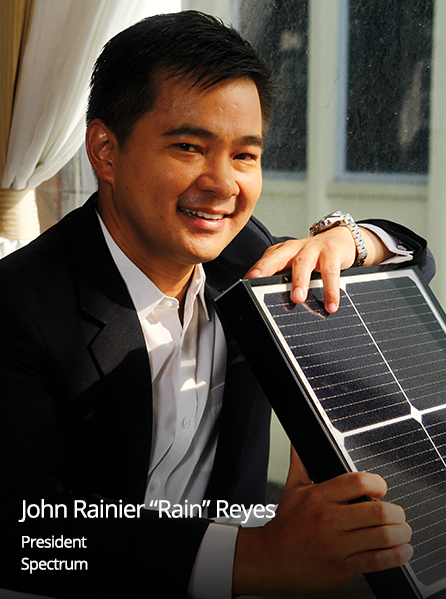 Meanwhile, Reyes remains keen on building the business by helping Meralco customers become their own power producers.
“We are a renewable-energy solutions company,” he underscores, “not solar-panel peddlers. We go to a customer, understand their requirements, and then provide a feasibility study. We will recommend and install the most beneficial solutions.”
One such customer is Shrinkpack Philippines Corp., which expects to generate over 11,283 kilowatt-hours (kwh) of electricity monthly from its recently installed solar-panel system (see “Wrapped Up in Innovation” on page 26). This reduced the company’s annual electricity bill by P800,000 to P900,000.
After a consultation, “If we see no benefit to the customer, we will advise against installing a solar-energy system," Reyes avows. "At least, for the time being, until economies of scale come into play.”
Meanwhile, Spectrum looks at microgrid projects to empower the countryside. “You have to make it sustainable; it has to be a business, not just a bleeding-heart project,” Reyes insists. “We’ve seen dole-outs of solar installations that are discontinued after two years.
“We have to understand the community; what will make it grow, what its potential sources of income are. We want to electrify the ecosystem of the community, not just the households.”
Being a trusted provider is one thing; getting trustworthy suppliers is another. To establish effective partnerships, Spectrum reaches out to manufacturers and suppliers of solar panels, inverters, mounting structures, and Balance of Systems units, which are photovoltaic system components other than the PV panels.
These partnerships are crucial given the rapid rates of change in RE technologies. Reyes foresees that “eventually, solar panels will move from the rooftops and appear directly on appliances and gadgets.
“Technology is going to challenge the industry, and Spectrum,” he promises “will be at the forefront of these developments.”