




A Fair Contract For Every Worker
by TINA ARCEO-DUMLAO
A drive to end repeated contractualization must contend with business realities
Maricel delos Santos looked forward to a bright future as an Information Technology student at a college in Laguna, but her dreams came to an abrupt end when she dropped out because her father, a tricycle driver, could no longer afford her education.
She remained optimistic, and eagerly sought employment at one of the biggest retail companies in the Philippines. Rather than receive a secure, lifelong job, she was offered a five-month, non-renewable employment contract as a sales associate in the ladies’-wear department.
Delos Santos signed on as a “seasonal hire”; she needed the job.
“The HR (human resources) department of the mall said it was a one-time deal,” Delos Santos reports in Filipino. “It was not what I expected, but I accepted it. It’s so hard to find a job, any job.”
She performed her duties as best she could, but when her contract ended, she was unable to find regular employment with guaranteed benefits and security of tenure.
“I want to be a regular employee, but if I’m offered another contractual job, I’d take it. I badly need a job,” narrates Delos Santos, 26, who temporarily stopped looking for work due to a high-risk pregnancy.
“I’ll look for work again as soon as I am ready,” she says.
 Promising to end ‘endo’
Delos Santos and others like her cheered candidate Rodrigo R. Duterte, who made a pledge at the third and final presidential debate last year: if elected president, he would put an end to “endo” within a week.
Short for “end of contract,” endo refers to the practice of hiring workers on five-month contracts to avoid providing the legally mandated pay rates and benefits due to regular, full-time employees. Labor laws entitle new hires that pass a six-month assessment period to be signed on as permanent employees; hence, the five-month endo period.
Although legal in the Philippines, contractualization can be prone to abuse by companies. Employers violate the rights of workers by engaging labor contractors to do the work of regular employees.
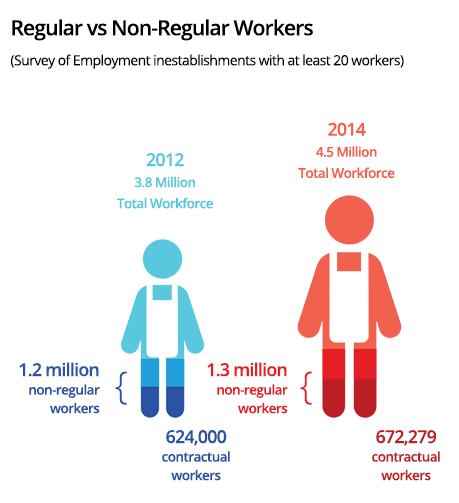
The Philippine Statistics Authority’s Survey of Employment in establishments with at least 20 workers shows that there were 1.3 million non-regular workers in the country in 2014. This accounted for close to 30 percent of the total establishment workforce of 4.5 million, 16.3 percent more than the 2012 number. Of these non-regular workers, about half, or 672,279, are contractual or project-based workers. This is a little less than the 2012 percentage of 52 percent. The balance includes probationary workers, casual workers, and apprentices.
Nearly a year since his vow to outlaw endo, President Duterte has grasped the complexity of what he, as an electoral candidate, had thought was an executive-order quick fix that simply required political will to resolve. Yet it is encouraging that the business sector is coming around to the government’s agenda.
 Extra staff during peak seasons
Involved in helping change endo is the Philippine Chamber of Commerce and Industry (PCCI), the country’s largest business organization with the broadest member base to represent the private sector.
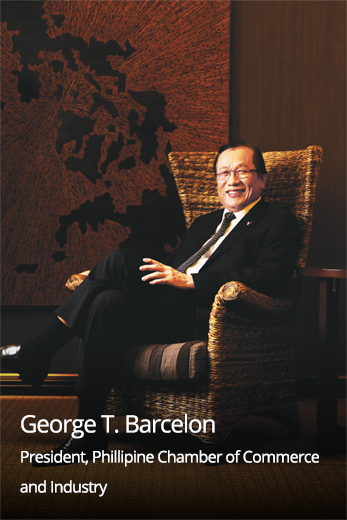
PCCI President George T. Barcelon is quick to stress that his organization supports the administration’s move to end illegal contractualization, and participates actively in high-level discussions spearheaded by the Department of Trade and Industry (DTI), as well as the Department of Labor and Employment (DoLE).
He insists the private sector must have the leeway to engage in contractual arrangements when the need arises: “When demand is high during certain times of the year, the number of needed workers can go up by as much as 30 percent.”
He singles out industries that call in additional staff: construction firms under time pressure; export businesses which need to meet large orders; hotels, resorts, and restaurants during peak seasons or special occasions.
There is also the complex, ever-changing nature of competition to consider. “Companies now want to spin off their non-core operations,” Barcelon explains, “or hire contractors to provide those non-core services” to keep its regular workforce focused on their main operations.
For example, food manufacturers job out cleaning and payroll services to keep their focus on research and development, marketing, and manufacturing.
Retaining the extra labor as regular employees – and providing benefits such as vacation leaves, health benefits, and retirement pay – could render less lucrative businesses non-viable, and force them to fold up.
Flexibility and abuse
“We have been very consistent in our stand that the workers’ rights must be considered,” declares Barcelon, “but we also hope to be given some flexibility.”
In previous administrations, this need for flexibility and healthy revenues justified the employment practice of contractual arrangements. When the system became prone to abuse, it prompted the DoLE, during the Aquino administration, to issue Department Order (DO) 18-A in November 2011, to provide guidelines regarding labor-only contracting schemes.
DO 18-A clarifies that contracting and subcontracting, “expressly allowed by law,” permits a company to farm out to a contractor “the performance or completion of a specific job, work or service within a definite or predetermined period.”
It compels contractors supplying such services to “provide employees [with] rights and privileges under the Labor Code, including security of tenure, retirement pay, leaves and safe working conditions.”
In keeping with President Duterte’s order to end endo, Labor Secretary Silvestre H. Bello III signed Department Order No. 174 (series of 2017), to supersede DO 18-A, on March 16. The new DO stops the direct contracting of regular jobs from manpower agencies, and prohibits the continuous hiring of a worker under repeated short contracts. It also entitles contracted or subcontracted employees to overtime pay, 13th-month pay, social security and retirement benefits, as well as the right to organize for collective bargaining agreements and the right to strike.
The new DO requires manpower agencies, which contract or subcontract employees for clients, to have a minimum capital of P5 million, a substantial increase from the previous requirement of P300,000.
Anti-endo labor groups such as Kilusang Mayo Uno complain that the order sides against the workers. DO 174 still considers seasonal and project-based contractual work legal, and does not cover contracting or subcontracting in the construction industry.
Enforcement and compliance
Labor Undersecretary Ciriaco Lagunzad III earlier explained it was impossible to simply repeal Department Order 18/18-A. Contractual work, although widespread, remains unregulated, so the DoLE is instead looking at roughly half a million business establishments to determine exactly how many contractual workers they employ.
At a Senate hearing, Labor Undersecretary Ma. Joji Aragon revealed that as of August last year, 5,150 registered contractors employed at least 416,000 contractual workers. These labor contractors are involved in manpower, security, janitorial, engineering and information-technology services, tracking and holding transport, and wholesale retail sales.
Speaking to the Employees Confederation of the Philippines, Bello reiterated that the abuse of contractualization erodes workers' rights when companies resort to short-term contracts to circumvent their legal obligations. Such schemes, declared illegal by the Supreme Court, continue to persist due to a lack of inspection and compliance.
Bello assured his audience that inspections will be “the main program in enforcing workers’ rights and ensuring full respect of labor standards, extending to contractual arrangements and the right of workers to security of tenure." After signing DO 174, the DoLE chief said he intends to hire 200 more labor inspectors to add to the present crop of 535.
Time to work
Barcelon has some reservations about some of the provisions in the new DO, particularly the lack of clarity on what constitutes the core and non-core operations that can be covered under a contractual arrangement. He is also concerned about companies being subject to harassment or extortion.
He concedes, however, that the department order must be given time to work, and welcomes DoLE’s plan to hire more labor inspectors to enforce the rules.
“We will just have to give this a chance and then do some adjustments down the road, if we need to,” Barcelon stresses. The PCCI, he says, does its part by reaching out to contractors, reminding them to provide mandated benefits to their workers, and police their ranks to prevent violations.
“What is important for us in the PCCI,” he reiterates, “is making sure that jobs are created.”
DTI Secretary Ramon M. Lopez, on the other hand, says that under the “win-win” proposal, contractualization can become a path to permanent employment (see “Encouraging Entrepreneurship” on page 18).
He refers to a proposal in discussion, where contracting agencies will be required to consider its workers as regular and permanent, with guaranteed tenure and benefits, even if a project with a principal is terminated. The DTI chief notes that this modifies the previous practice where employees of contracting agencies lose their jobs once the contract ends between their agency and the principal.
The political will to enforce the provisions of the existing laws and regulations already bears fruit, with the numbers to show it.
After consultations and meetings with corporations, by the fourth quarter of 2016, DoLE figures show about 32,437 workers were granted job security when their employers and contractors made them regular employees; more companies are expected to follow suit.
Whether driven by self-interest or good intentions, business and government are keenly aware that the realities of maintaining competitiveness and viability will keep contractualization necessary and legal. For low-skill workers like Delos Santos, the prospect of full, long-term employment will, for now, remain an elusive goal.