



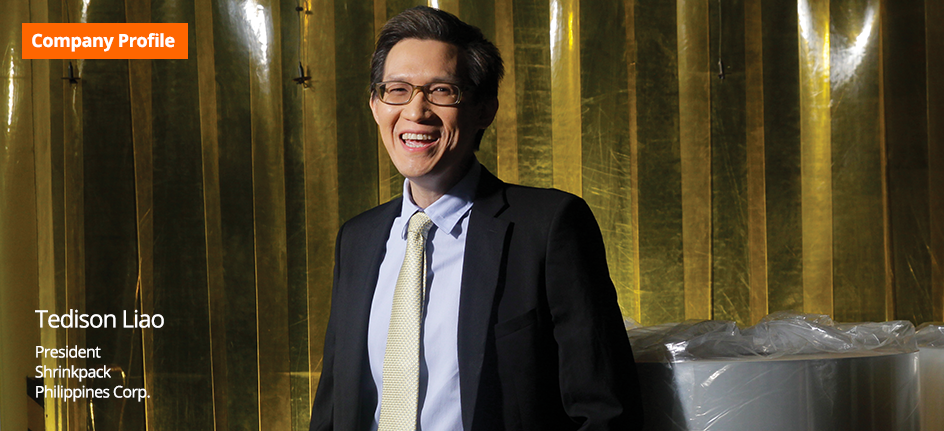
Wrapped Up In Innovation
by Ma. Melin C.Y. Doria
Shrinkpack has big plans to make things smaller
It’s an item most people eagerly throw away: the snug film of thin plastic that covers most of the drinks, confections, cosmetics, and other consumer merchandise sold at malls, supermarkets, and sari-sari stores.
Shrink wrap can protect products during shipping, bind two or more products together, provide a tamper-proof seal, or display the branding label. As new products materialize on retail shelves, opportunities and challenges abound for companies that supply shrink wrap – companies like Shrinkpack Philippines Corp.
Competition breeds innovation
A shrink-wrap packaging pioneer in the Philippines, the company has seen steady growth since it was founded in 1989. According to Shrinkpack President Tedison Liao, “It may not be a sunrise business anymore, but it isn’t a sunset business, either.”
Despite keen competition and an ever-shifting market, Shrinkpack stays ahead of the game by pursuing several progressive strategies. Constant innovation, emphasizes Liao, is one of them: “Innovation is the name of the game, and we have to be ahead of our competitors.” The purchase of sophisticated and state-of-the-art manufacturing equipment greatly increased the firm's productivity, improved the quality and reliability of its products, and further expanded business opportunities.
At a new factory in Meycauayan, Bulacan, Liao describes the range of products available, such as polyethylene terephthalate (PET) shrink labels. Its strength and excellent transparency makes PET the most-used type of plastic on the planet. It has the highest shrinking capability (up to 80 percent), highly ideal for labels and packaging.
The company also makes shrink films and film labels of polyvinyl chloride (PVC); its shrinking quality is generally between 40 and 65 percent but it costs less than PETs. Another wrap material, oriented polystyrene (OPS), is a low-density, easily compressed film often used for containers.
The Shrinkpack boss believes business is always an open market, admitting that some of their clients opted to purchase similar equipment to produce plastic labels in-house. Liao meets this challenge with a smile, and uses it as a further incentive to spur on innovation.
Improvements are not limited to equipment upgrades. Liao also pursues a policy of strengthening business partnerships and relations with both local and overseas multinational companies. He is confident that domestic firms will prefer to support fellow local counterparts, such as Shrinkpack.
“We treat them not only as customers but as partners,” he explains. “That means having a give-and-take relationship that, in the long term, becomes more and more productive.”
A sunny partnership
This same approach applies to the companies supplying Shrinkpack, such as the Manila Electric Co. (Meralco), which collaborates with the packaging company to find efficiencies wherever possible.
Like any part of a business supply chain, Shrinkpack must be able to keep its prices low or, at least, stable. With the weakening peso versus the US dollar, meeting that criterion has become increasingly difficult.
To keep costs down, the company uses equipment such as solar photovoltaic (PV) panels to tap alternative energy sources. “We are aggressive,” Liao declares, “and we always try to be the first in everything.”
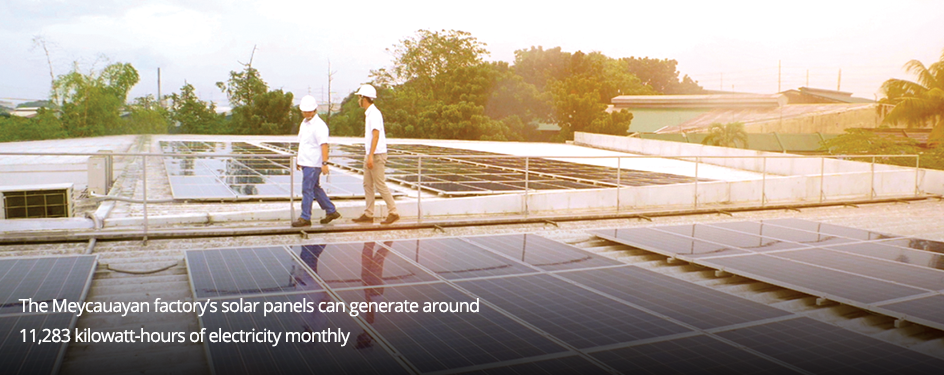
Indeed, Shrinkpack is one of the first Meralco customers to have solar PV panels installed through the power distributor’s subsidiary, Spectrum (see “The Sun Rises on Solar Power” on page 30).
Its 324 polycrystalline solar PV panels (102.06 kilowatt peak), which cost around P7 million (VAT excluded) to install atop Shrinkpack’s office and warehouse, are expected to generate around 11,283 kilowatt-hours of electricity monthly. This will save the company between P800,000 and P900,000 annually. This should earn Shrinkpack a full return on its investment by 2025, or in eight years with operations and maintenance support.
Aside from being a welcome source of supplementary power, the solar energy system, Liao announces, neatly dovetails with his company’s other environmental practices such as plastics recycling. In the long run, the savings generated by the alternative power system will enable the company to invest in new, even more efficient equipment, better inks, and printers.
“Our advantage has always been about quality,” concludes Liao, “and it still is. Quality will always be our driving edge.”