



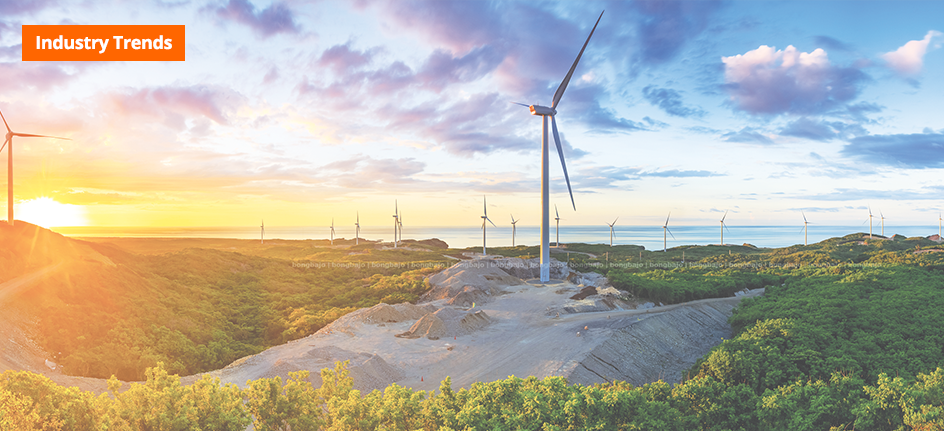
A Future Renewed
by CHERRIE REGALADO
Even with the restrictions of red tape, there’s a bright outlook for green energy
Free energy is all around us: sunlight, wind, water. The irony, of course, is that harnessing such energy sources has always been fairly expensive.
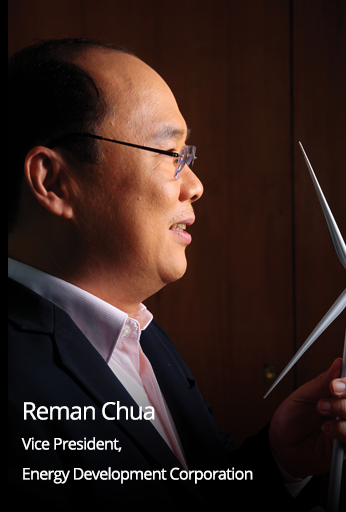
On the other hand, the use of “cheap” fossil-fuel energy sources such as coal, diesel, and bunker oil carries longer-term, environmentally damaging costs. The growing awareness for this parallels an increasing clamor for cleaner and greener energy worldwide, observes Reman Chua, vice president of Energy Development Corp. (EDC), one of the Philippines’s largest producers of geothermal energy.
“Renewable energy is the future,” he declares. “It’s a trend that is coming to the Philippines.” And this gradual shift now gets the nod of the government: President Rodrigo R. Duterte signed the Paris Agreement on Climate Change on March 1; the Senate ratified it with a unanimous vote.
 Degrees of improvement
The driving forces behind the Conference of Parties (COP) will certainly approve. The COP is a union of countries that signed the United Nations Framework Convention on Climate Change, also referred to as the Paris Agreement, to mitigate rising atmospheric temperatures. The participants agreed in December 2015 to slash greenhouse gases and keep the global average temperature increase well below two degrees Celsius above pre-industrial levels.
This agreement compels countries represented by nearly 200 world leaders to shift from coal and diesel power to renewable energy (RE). Wealthy countries were asked to earmark at least US$100 billion annually for its financial assistance to developing countries, ideally to enable even the latter to actualize RE sources starting 2020.
Although the Philippines is not a major greenhouse-gas producer, President Benigno S. Aquino III pledged that by the year 2030, the country will cut its carbon emissions by 70 percent.
In signing the pact, Duterte overrode misgivings he expressed early in his presidency, saying the historic agreement favors industrialized nations. But Climate Change Commissioner Emmanuel de Guzman is gratified that “the Philippine delegation’s hard work, to lobby the 1.5-degree climate goal during the Paris negotiations, has finally paid off.”
While treaties and government support provide some impetus to adopt RE resources, the real game-changers
are the improvements in technology and manufacturing that make the cost of RE more competitive.
A century of hydropower
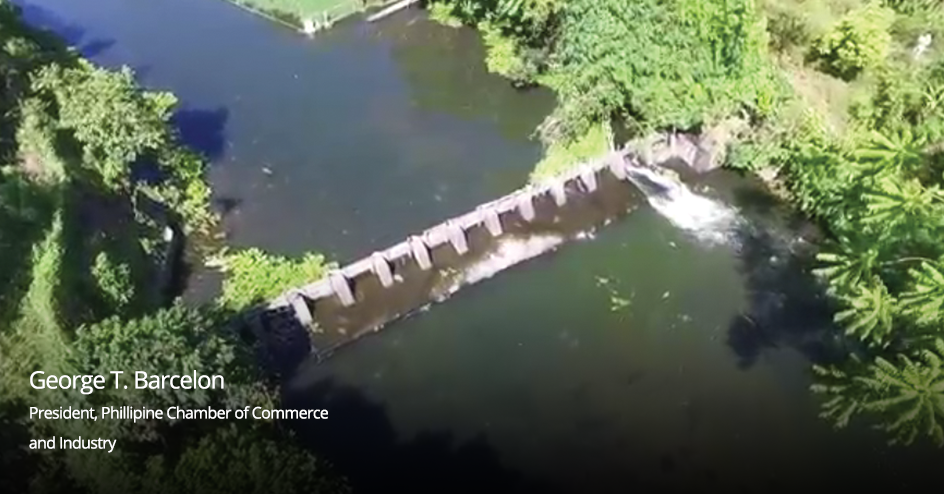
Renewable energy is not a new concept, with the first hydroelectric power plant built in the United States in 1882. It’s a tried-and-tested technology undergoing refinement over the decades.
Victor Lee, chief financial officer of Pure Energy Holdings Corp., announces that his company’s subsidiary, Repower Energy Development Corp., is developing 15 river hydropower plants with a combined total capacity of 52 megawatts (MW).
Hydropower facilities, Lee points out, last longer than the 25-year asset life of coal or diesel-fueled plants. “These hydropower plants last for decades and decades,” he adds. “We have the oldest operating hydropower plant in the country built by the Americans 90 years ago. It’s still operating its antiquated equipment; that’s how long these assets work!”
RE is predicted to overtake coal production in the next two decades. The Bloomberg New Energy Finance report forecasts around two-thirds of total investments in the global energy sector, roughly US$7.8 trillion, will likely be invested in renewables from 2016 to 2040. This far exceeds the expected US$1.2-trillion investments in coal plants for the same period.
Industry insiders believe the Philippines has the potential to lead the world in RE production, with the country's abundant natural resources estimated to yield 246,000 MW of untapped RE capacity.
For now, the country remains largely dependent on coal-powered plants for its energy needs. Data from the Department of Energy (DOE) shows that in 2016, 48 percent of energy came from fossil-fuel plants, with only 24 percent from renewables.
EDC’s Chua highlights the RE sector’s major milestones in recent years, such as surpassing DOE targets for solar- and wind-power installation, but agrees there is much room for improvement. “We’ve achieved a lot as a young industry,” he admits, “but it’s a drop in the ocean compared to that of other countries in terms of capacity.”
A push for faster approvals
The government passed Republic Act No. 9513, the Renewable Energy Act of 2008, to accelerate the growth of the RE sector and reduce the country’s heavy reliance on fossil fuels. Working with this national policy framework in mind, the government launched the National Renewable Energy Program in 2011, setting a target to increase the RE installed capacity threefold from 5,439 MW in 2010 to 15,234 MW by 2030.
RE developers concur that more government support is needed. Bureaucratic red tape only increases the cost of building new power plants and adds to the financial stress of undertaking such large investments.
Chua recounts EDC’s hardships in building the 150-MW Burgos wind farm. He confides, “We had to apply for some 200 permits, and I had to sign some 10,000 documents in a span of 14 years! And that’s just for the right-of-way for the 43-kilometer transmission line.”
Lee calls on the government to streamline its processes, and possibly open a one-stop shop that will facilitate the quick and efficient release of licenses and permits required by RE companies. Aside from right-of-way issues to be settled with local government units, there are dealings with agencies such as the Department of Environment and Natural Resources (DENR), the Energy Regulatory Commission (ERC), and the National Grid Corp. of the Philippines (NGCP).
At present, developers are forced to hop from one government office to another, through “what I’d call an alphabet soup,” Lee continues. “There’s the DENR, DOE, ERC, NGCP and so on. If we can get through the development process in two years, we’d already consider that very, very speedy. That calls for a company to have a lot of stamina and financial capacity to bring the project to fruition.”
This is not news over at Solar Philippines, a developer of solar-rooftop power plants. Its president, Leandro Leviste, likewise advocates the simplification of the government’s approval processes. He believes this will do more to advance the growth of the RE industry than the incentives provided by law.
The government offers a seven-year income-tax holiday, reduced corporate taxes, and duty-free importation of machinery. This may entice the private sector to venture into the RE sector.
However, it remains debatable if these can offset the investors’ soft costs. These include professional fees for architects, surveyors, engineers, lawyers, and accountants, as well as government fees and permits, utility hookup fees, and construction period interest and loan fees.
“All power is more expensive,” discloses Leviste, “because of the level of bureaucracy and red tape that is priced into our electricity. Twenty percent of a solar farm is soft cost. Instead of subsidies, government should just eliminate these barriers.”
He also urges the government to stop its planned additional feed-in-tariff (FIT) for qualified developers. The FIT is a mechanism that guarantees payment to RE suppliers for power supplied at a fixed price.
Leviste is convinced the scheme has done more harm than good to RE developers. “The FIT was counterproductive within the Philippine RE industry,” he explains, “because it created the perception that RE is expensive.”
Competitiveness buoys optimism
According to Chua, “Delays in any regulatory response to support renewable energy create problems, even if a law mandates the government to promote RE development in the country.”
He insists that, given the right conditions, RE can be produced at a competitive price, despite the higher capital outlay for the power plants.
“EDC’s three wind farms in Ilocos Norte contributed to a savings of P4 billion in the spot market,” he discloses, “because it displaced more diesel and bunker-fueled plants from the grid.”
Leviste, meanwhile, reveals that the drop in solar energy-generation prices globally defies naysayers. Solar energy today costs P4 per kilowatt-hour; he says this makes it less expensive than the average cost of coal in the country. “Solar power is now proven to be not only cleaner, but cheaper,” he stresses. “The challenge is in making the switch to solar, and we hope to do that this year.”
Shortly after the government’s launch of the National Renewable Energy Program, the Manila Electric Co. (Meralco) incorporated a solar-energy subsidiary. (See “The Sun Rises on Solar Power” on page 30.)
This subsidiary, Spectrum, heeds the demand for RE in what its president, Jose Rainier A. Reyes, calls a golden age for the solar-power industry. It aims to assist Meralco customers in self-generating power with solar-energy installations guaranteed to work with the existing power infrastructure.
Spectrum also teamed up with a local and a Singaporean company for a joint venture scheduled to open a 50-MW solar-power plant by 2018.
Despite bureaucratic restraints, the economy’s continued upward trajectory gives the RE industry cause for optimism. There is even consensus that the sector can meet the government’s target of tripling RE capacity by 2030. “As long as there is a stable and supportive regulatory environment,” declares Chua of EDC, “it is achievable.”
Given all the beneficial economic and social implications of lower RE power costs, may that day be not too far into the future, when so-called free energy can be permanently generated competitively. (With Ma. Melin C. Y. Doria)